


Hello,
October was the busiest month EventTracker has recorded. The seven exchanges that publish their own daily numbers traded $3.84 billion a day, 54% more than in September, and our board carried more markets than ever: 55,318 on October 25, across 29 venues.
It was also two markets at once. By volume, October belonged to the weekend: combos, the exchanges’ version of a parlay, made up two thirds of Kalshi’s trading, and every Sunday since early September beat the one before it. By the size of single trades, it belonged to the ballot box: more than half of the big-ticket dollars on Polymarket went to election markets, in Brazil, in Israel and in the US midterms on November 3.
Below are the numbers for every marketplace we track, what happened around them, and what we are watching in November.
The exchanges’ own numbers
Seven exchanges publish an official report of each day’s trading: Kalshi, Polymarket US, Novig, Nadex, UDX, Rothera and ProphetX. Those reports are the most reliable volume figures in this market, so we start with them.
In the first thirty days of October the seven traded $115.2 billion between them, an average of $3.84 billion a day against $2.49 billion in September. The busiest day was Saturday, October 24, at $6.53 billion, the highest since we began reading all seven in August. And each of the last seven Sundays beat the one before it, from $1.87 billion on September 6 to $6.23 billion on October 25.
A word on what these numbers are. The volume here is notional: the face value of the contracts traded, not cash changing hands. It is the standard measure, and the right one for comparing exchanges, but it is not money spent.
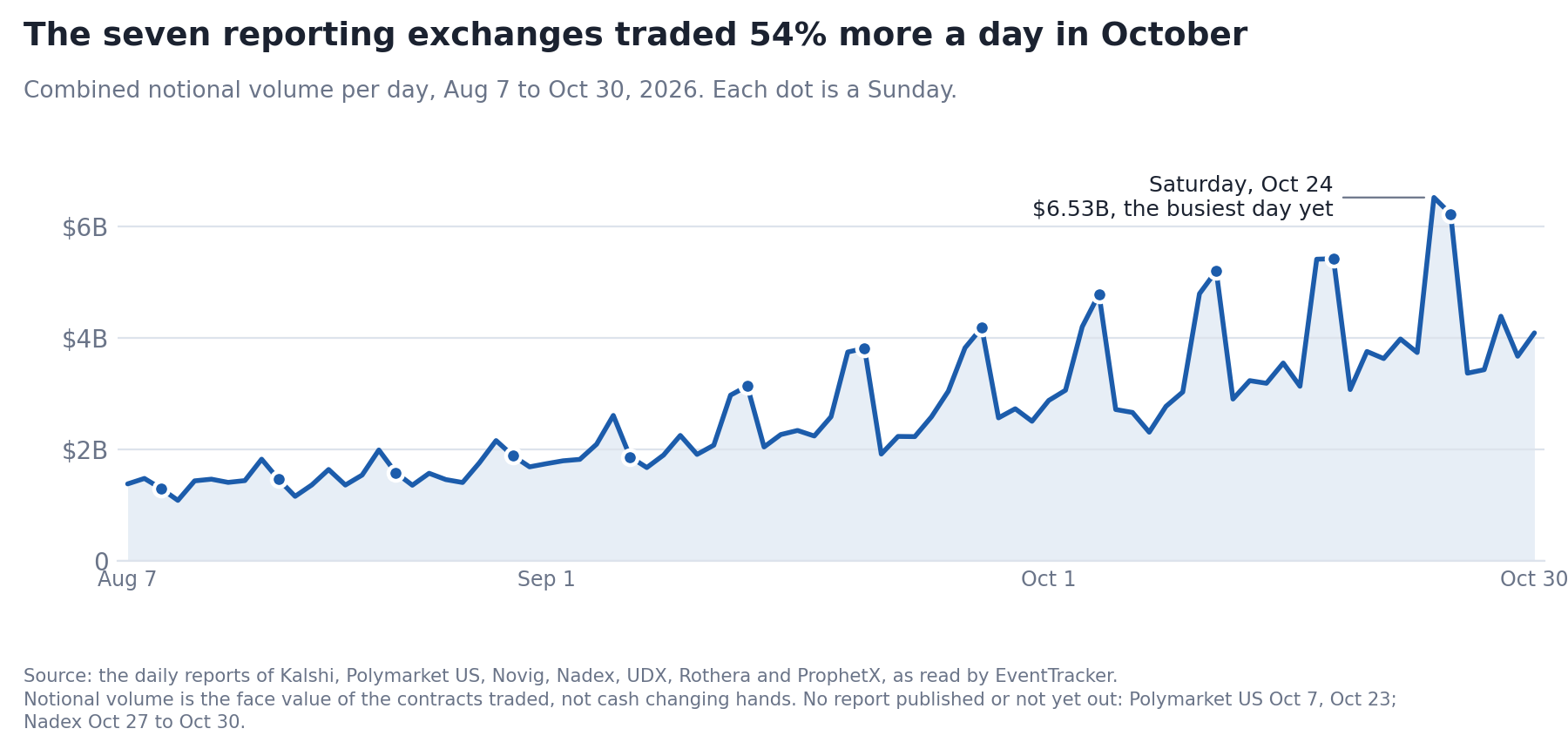
Figure 1. The seven reporting exchanges, every day since August 7. The dots are Sundays. A few October days read slightly low: Polymarket US published no report for October 7 or 23, and Nadex had reported only through October 26 when we went to press.
All seven grew. UDX and Novig more than doubled. Kalshi, which accounted for 81% of the seven’s volume, grew 53% to $3.11 billion a day. At that pace Kalshi’s own reports add up to about $1.1 trillion a year, in line with the “over $1 trillion annualized” it claimed when it announced new funding on October 29. Rothera, the one exchange that barely moved, was up 6%.
Table 1. The seven reporting exchanges, October against September
| Exchange | September, per day | October, per day | Change | Share of the seven in October |
|---|---|---|---|---|
| UDX | $24.0M | $61.5M | +156% | 1.6% |
| Novig | $48.2M | $103.6M | +115% | 2.7% |
| Polymarket US | $290.0M | $477.4M | +65% | 11.6% |
| Kalshi | $2.03B | $3.11B | +53% | 81.0% |
| Nadex | $55.3M | $78.0M | +41% | 1.8% |
| ProphetX | $8.0M | $9.9M | +24% | 0.3% |
| Rothera | $38.5M | $41.0M | +6% | 1.1% |
| All seven | $2.49B | $3.84B | +54% |
Two thirds of Kalshi is now combos
A combo packs several outcomes into one contract, and it pays only if all of them come true. Kalshi reports its combos separately, and the trend is hard to miss: they were 45% of its volume in August, 58% in September and 68% in October.
In dollars, Kalshi’s combos grew from $575 million a day in August to $2.11 billion in October, more than three and a half times. Its single contracts grew too, from $716 million to $1.00 billion, but far more slowly. Of every dollar Kalshi added to its daily volume since August, 84 cents came from combos.
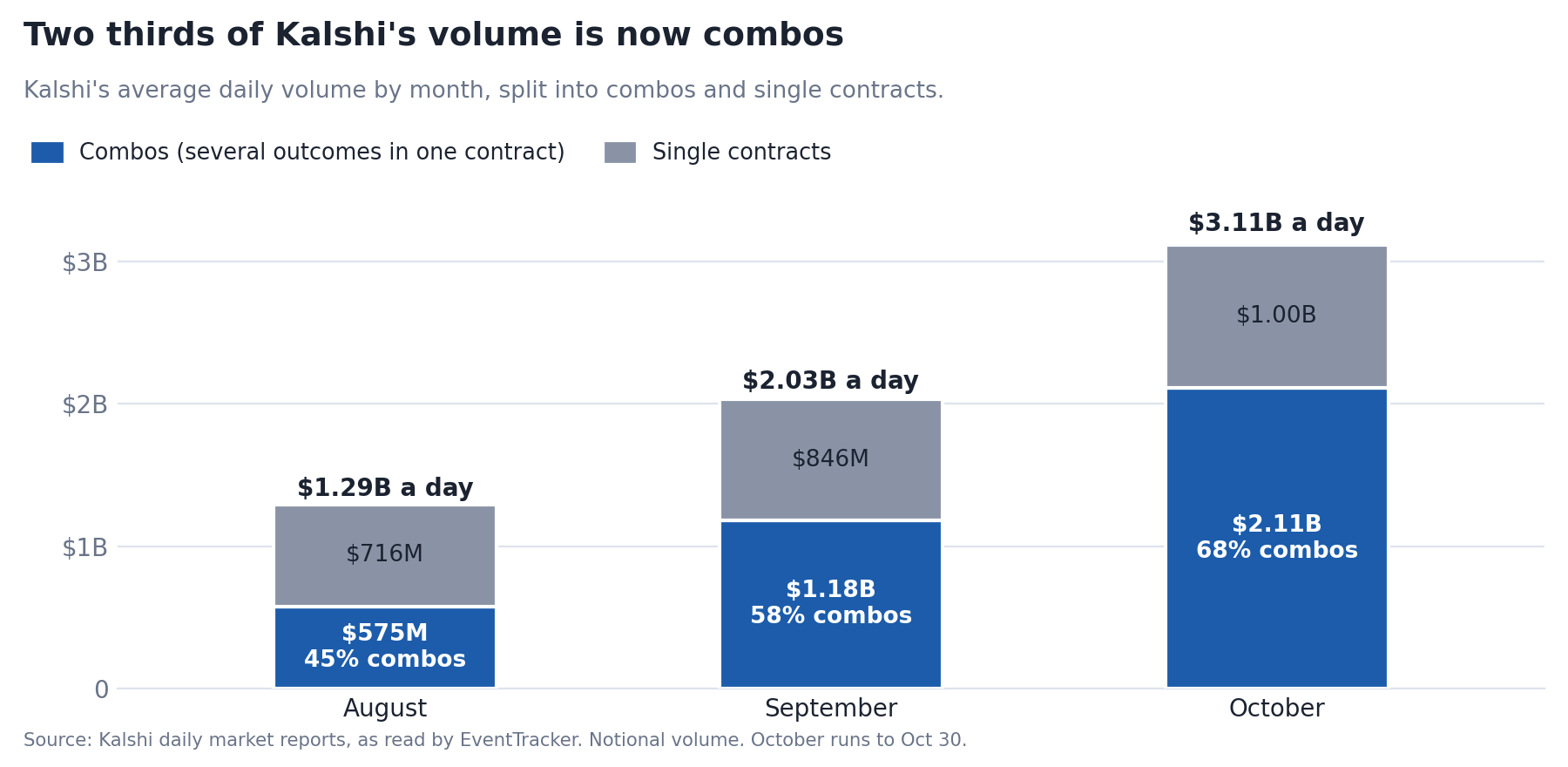
Figure 2. Kalshi’s average day, by month, from its own reports. Combos in blue, single contracts in gray.
Combos are also the hardest prices to compare, because no two venues build them the same way. More on that below.
Open interest kept building
Open interest is the value of contracts still open at the end of the day: money committed to outcomes not yet decided. At the six exchanges that report it, open interest rose from $1.89 billion on September 30 to $2.86 billion on October 30, up by about half, and it rose at every one of them. Kalshi’s reached $2.17 billion. UDX’s and Novig’s roughly doubled.
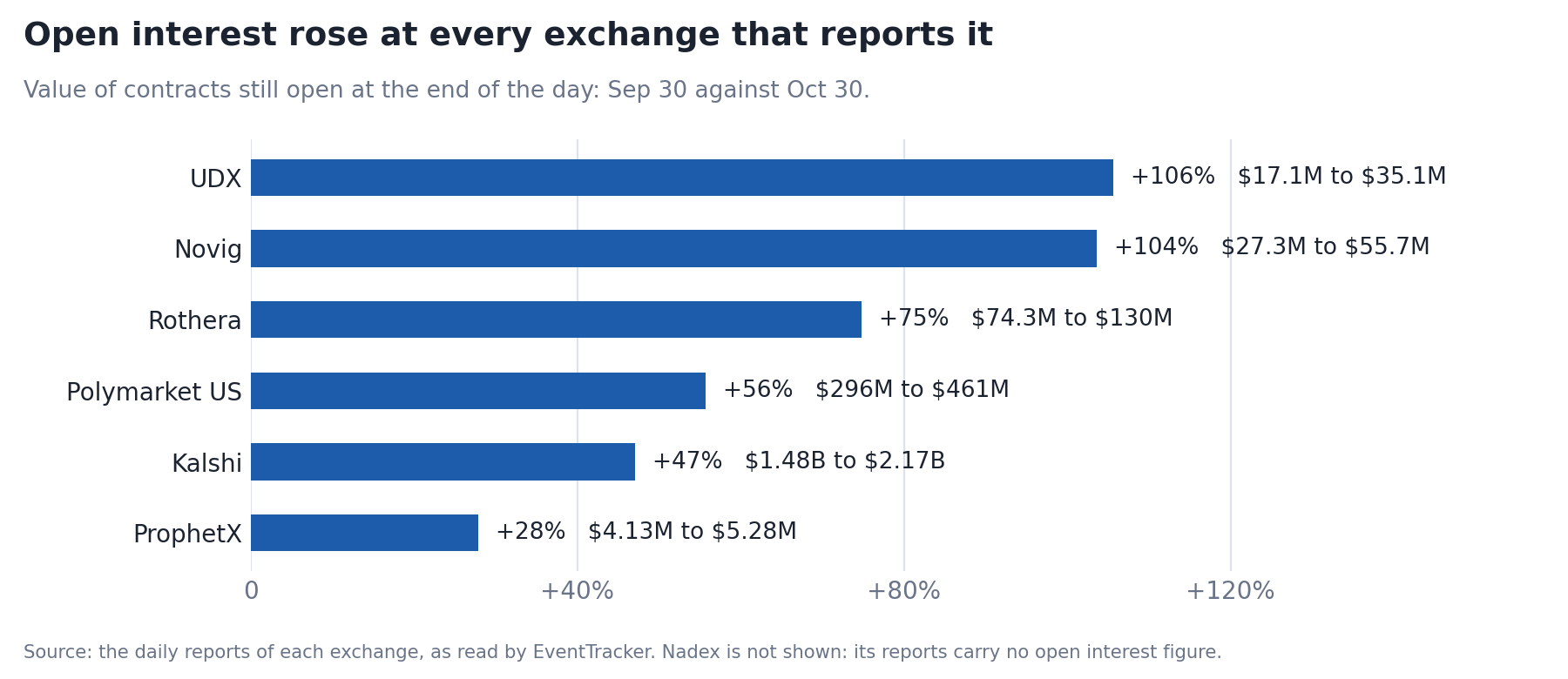
Figure 3. Open interest, September 30 against October 30. Nadex’s reports carry no open interest figure, so it is not shown.
Every marketplace, one by one
Here is each of the seven on its own scale, September in gray and October in blue. The weekly rhythm is easy to see: most peaks fall on weekends.
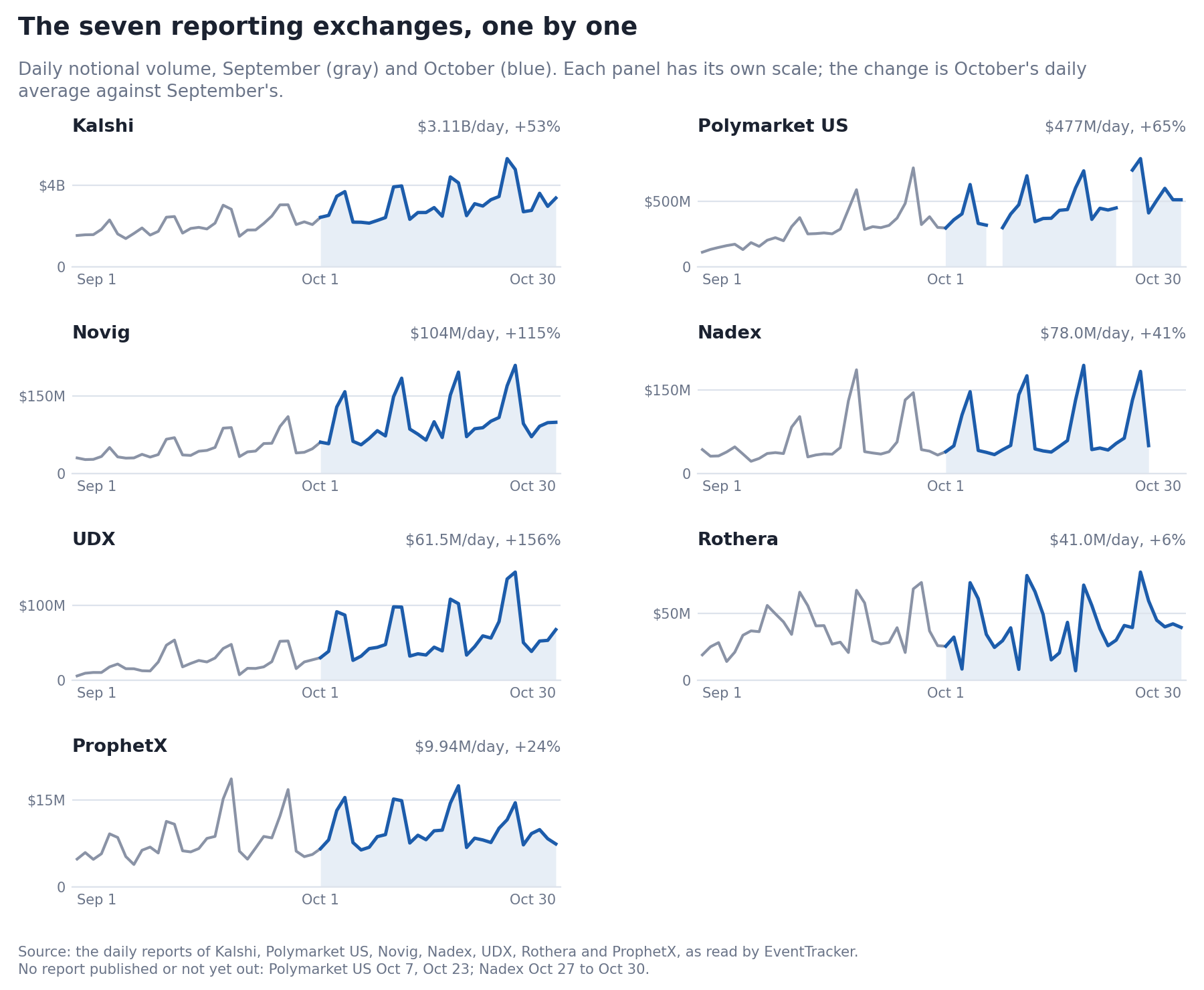
Figure 4. The seven reporting exchanges, one panel each. The change is October’s daily average against September’s.
For every other venue on EventTracker, the number is one we measure ourselves: the volume on the events we track. That makes it a floor rather than the venue’s full volume, and it cannot be added to the official figures above. It is still the best way to see which way each venue moved, as long as you keep one thing in mind: when we start tracking more of a venue’s markets, its number rises even if nothing changed there. Those venues are flagged in the chart.
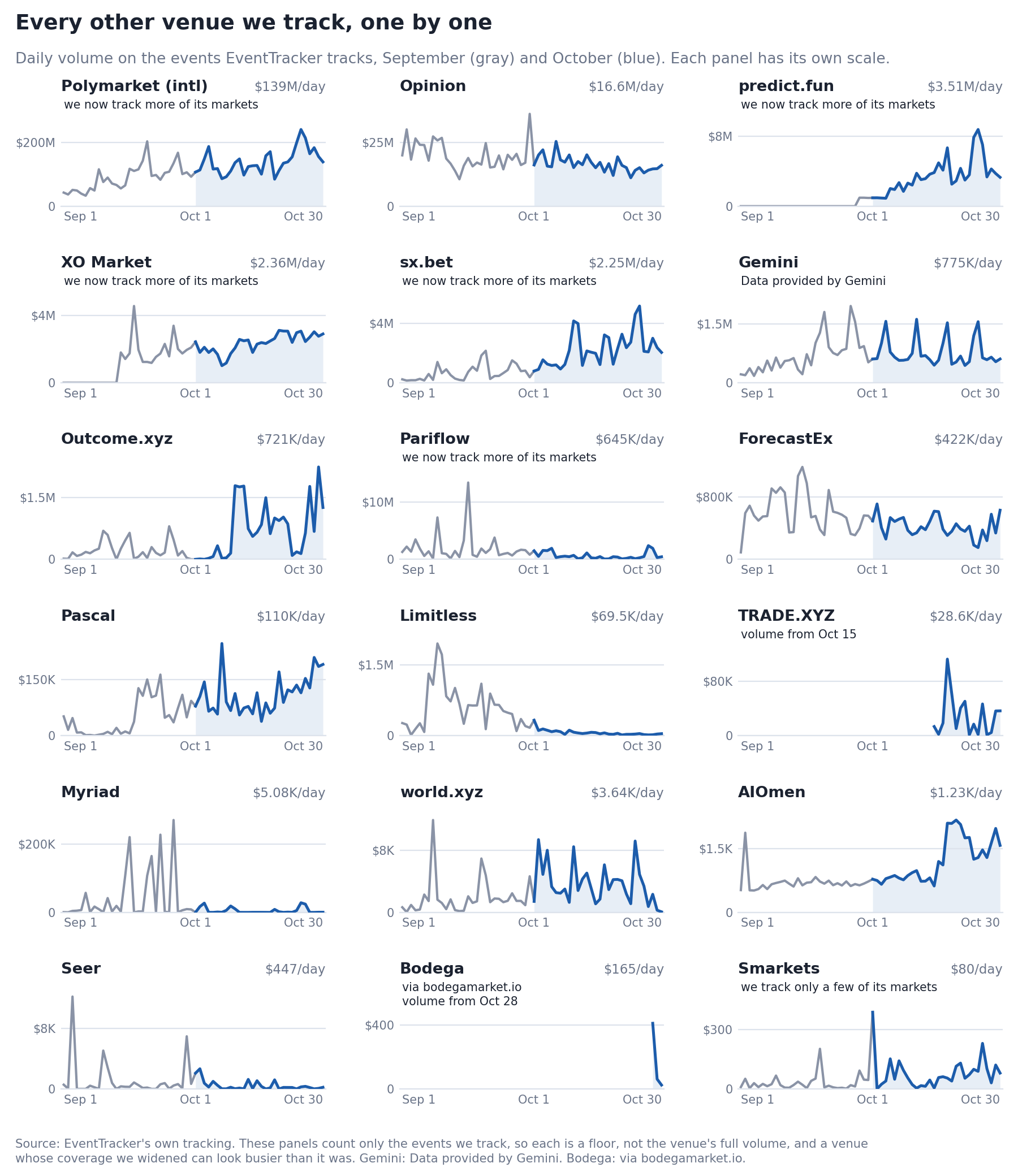
Figure 5. Every other venue we track, ordered by October’s daily average. “We now track more of its markets” marks a venue whose rise is partly our own wider coverage.
What stood out:
- Polymarket’s international exchange averaged $139 million a day on the events we track. We widened our Polymarket coverage on September 16, so the fair comparison is with the second half of September, and on that basis it was up 18%.
- Opinion slipped 18%, to $16.6 million a day, on steady coverage.
- Outcome.xyz more than tripled, to $721,000 a day, on much the same set of markets.
- sx.bet ($2.25 million a day) and predict.fun ($3.51 million) rose sharply, but we now track far more of their markets, so much of that rise is our coverage, not the venues.
- Pariflow fell 67% even though we now track more of its markets, and Limitless fell 89% on similar coverage. Both are real declines on the events we follow.
- Gemini rose 11%, to $775,000 a day. Data provided by Gemini.
- New this month: TRADE.XYZ, event contracts traded on Hyperliquid, with volume from October 15; Trueo, prediction markets on the Base network, listed from October 24 with prices but no volume figure yet; and Bodega, on Cardano, from October 28 (via bodegamarket.io).
Where the big tickets went
Our whale tape records every single trade of $2,000 or more on Polymarket’s international exchange. In October (through the 30th) it caught 16,778 of them, worth $134.4 million, and $74.6 million of that, 55%, went to election markets.
Half of the month’s big-ticket dollars landed in just five days, October 25 to 29: Brazil’s presidential runoff on the 25th, the Ballon d’Or on the 26th, Israel’s election on the 27th and the Federal Reserve’s decision on the 28th.
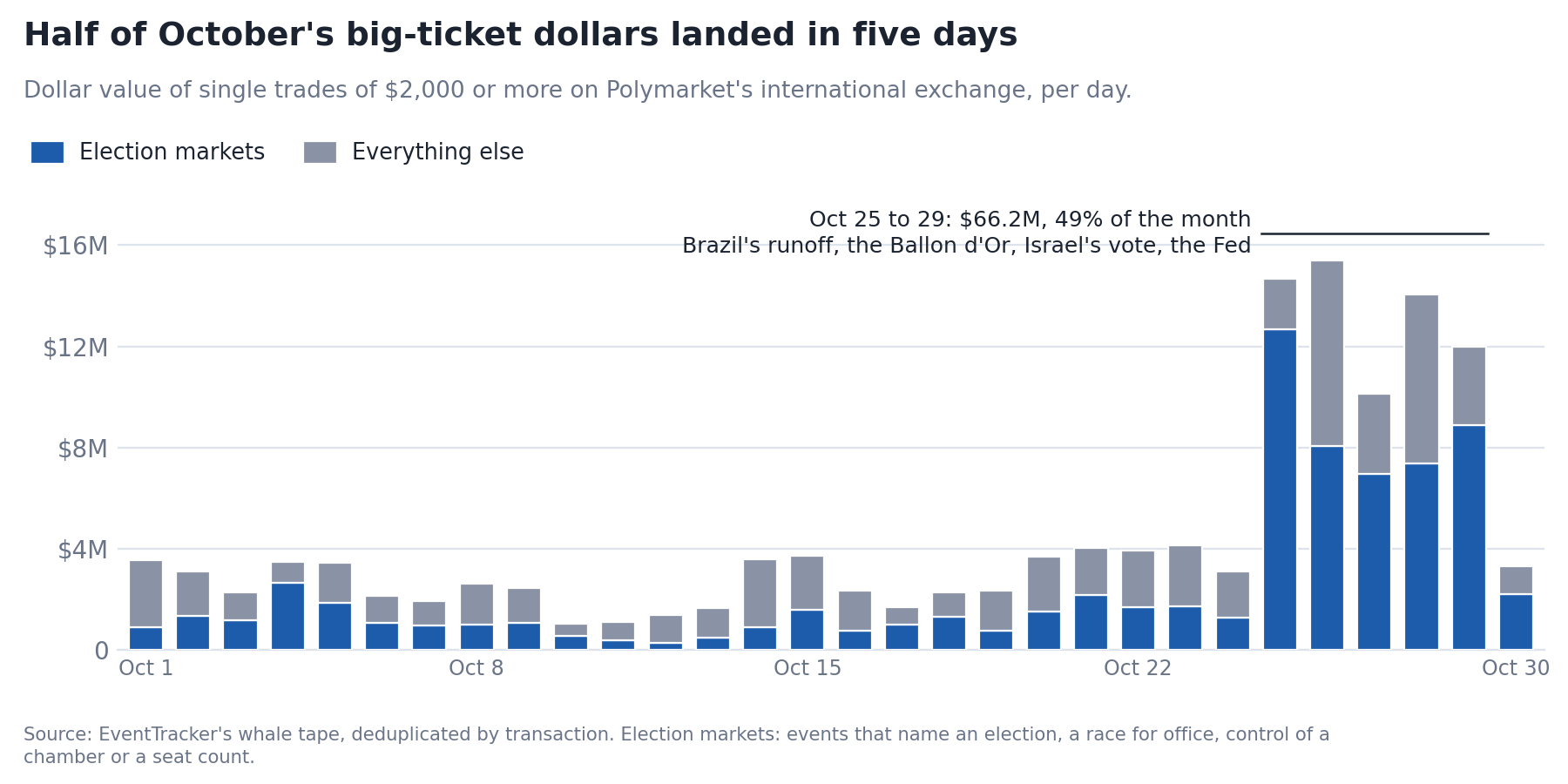
Figure 6. Single trades of $2,000 or more on Polymarket’s international exchange, per day in October. Election markets in blue.
Table 2. Where October’s big tickets went
| Event on Polymarket | Big tickets | Dollars |
|---|---|---|
| Brazil presidential election | 2,875 | $25.8M |
| Fed decision in October | 1,622 | $17.6M |
| Which party will win the House | 612 | $10.1M |
| Next prime minister of Israel | 1,308 | $9.8M |
| Ballon d’Or winner | 942 | $7.1M |
| Balance of power, 2026 midterms | 560 | $6.5M |
| Israeli legislative election winner | 617 | $5.3M |
| Will the US invade Iran before 2027 | 304 | $3.1M |
| Texas Senate race | 292 | $2.2M |
| Which party will win the Senate | 242 | $2.1M |
Israel’s three biggest election markets drew $16.3 million between them, and the four biggest US midterm markets more than $20 million.
The single biggest ticket of the month was a sale: $1.36 million of Lula “Yes” at 99.35 cents on October 26, the day after he won, cashing out rather than waiting for the market to settle. The second biggest, $748,000, bought “No” on a Fed hike of half a point or more, at 99.7 cents, on decision day.
The month around the markets
October was also a month of courtrooms, rulebooks and one very large funding round.
- October 9. The CFTC proposed writing event contracts on sports, politics, culture and weather expressly into the legal definition of a swap, and issued an interim rule that casino-style products are not swaps. Comments are open for 30 days from the October 19 notices.
- Mid-October. The SEC approved Cboe binary options that settle on company figures reported in SEC filings, starting with 23 companies, with Robinhood lined up as the first retail broker. Trading had not yet started when the approval was reported.
- October 20 to 28. Utah’s attorney general sued Kalshi and two Susquehanna market-making firms in state court. The CFTC then sued Utah to block its enforcement (October 27), and local outlets reported that Utah had filed 14 criminal counts against Kalshi and its co-founders (October 28). Kalshi called it “a crazy overreach”.
- Late October. Kalshi sued Missouri and its attorney general in federal court, after a September cease-and-desist order on its sports contracts, arguing that only the CFTC can regulate it.
- October 26. The NBA named Kalshi and Polymarket its “Preferred Prediction Market Exchanges”, barred league and team staff from trading NBA contracts, and signed an information-sharing agreement with the CFTC. On October 30 the Philadelphia 76ers made Kalshi their official prediction market partner.
- October 29. Kalshi raised $1 billion at a $40 billion valuation, in a round co-led by Wellington and Sequoia. Its announcement also claims more than 75% of the industry’s trading; that figure is Kalshi’s own.
- October 29. Polymarket paused its international exchange after unauthorized withdrawals tied to a compromised outside provider, resumed that afternoon, and said it would return $3.9 million to affected traders. CNBC reported that the US platform was not affected.
And the results behind the big tickets:
- Brazil. Lula was re-elected in the October 25 runoff with 51.79% of valid votes, against 48.21% for Flávio Bolsonaro, according to Brazil’s electoral court.
- Israel. Israelis voted on October 27. In near-final counts Likud is the largest party with 27 seats, and neither bloc has the 61 seats needed for a majority. Official results are expected by about November 4.
- The Fed. The Federal Reserve held its target range at 3.75 to 4 percent on October 28. Two of the twelve voters, Lisa Cook and Beth Hammack, preferred a quarter-point increase.
- Ballon d’Or. Harry Kane and Alexia Putellas won in London on October 26.
- Nobel Peace Prize. Awarded on October 9 to Navi Pillay.
- World Series. The Milwaukee Brewers beat the Tampa Bay Rays four games to one, clinching the franchise’s first title on October 28.
Three threads run through all of this. The fight over who regulates these markets is now in court on every front: the CFTC writing rules and suing a state, states filing civil and criminal cases, and venues suing first. With New Jersey’s petition pending at the US Supreme Court, the final word may come from there. Integrity rules are arriving through contracts and a second regulator: the NBA’s data-sharing agreement and trading bans, and the SEC’s new lane for contracts on company figures. And money and attention are concentrating before the midterms, which raises the stakes when something breaks, as Polymarket’s pause showed.
What we are watching in November
- November 3, the US midterms. Control of the House drew $10.1 million in big tickets on Polymarket in October. We will be watching how prices move across venues on the night.
- Israel’s official results, expected by about November 4.
- New Jersey’s petition at the US Supreme Court, where Kalshi’s response is due November 9.
- The CFTC’s comment period on its swap proposal, open for 30 days from October 19.
October on ET&
October’s three trends are the three things ET& is built for. Combos, now two thirds of Kalshi’s volume, are the hardest prices to compare, and ET&’s Combos & parlays board lines them up across venues, each row stamped with how old its price is. The money moved in bursts, half of the month’s big-ticket dollars in five days, and on days like those a 15-minute snapshot is a long time: ET& re-prices the top markets about every 45 seconds, and its arbitrage engine re-checks the price gaps between venues on the same cycle and posts them to your Live Alerts feed. And when a single trade runs to $1.36 million, you may want to know the next time that wallet moves.
With ET& you can follow up to 50 wallets and 50 events (a free account follows one of each) and get Telegram alerts when they move, when a price target you set is hit, or when a gap opens between venues. You also get the TeeKee score, a 0 to 100 confidence read on events listed on more than one venue; Smart Money On, which shows where Polymarket prices sit against the sportsbooks’ consensus line; a live fair price; and the Hot Events and Cross-Venue boards. ET& is $22 a month, or $199 a year, about three months free, and every plan starts with a 7-day free trial you can cancel anytime.
See everything ET& adds · Start your free trial
A month like this is easy to read as a straight line up. It was not quite that: the gains came from combos and a handful of very big days, and some smaller venues lost ground. We will keep measuring it the same way every month, so you can see which of these trends last.
Tal Ayalon Co-Founder & CEO, PodComet LLC
Official volumes and open interest are each exchange’s own daily reports (Kalshi, Polymarket US, Novig, Nadex, UDX, Rothera and ProphetX), as read by EventTracker, through October 30. Every other venue is EventTracker’s own tracking of the events we follow: a floor, not a full count. Gemini data: Data provided by Gemini. Futuur data via futuur.com. Bodega data via bodegamarket.io. Big tickets are single trades of $2,000 or more on Polymarket’s international exchange, from EventTracker’s whale tape. World events are from public sources, among them the CFTC, the Federal Reserve, Brazil’s electoral court, the NBA and Kalshi’s own announcement. EventTracker is an independent, unaffiliated, display only aggregator. We take no wagers and hold no funds. Nothing here is investment or wagering advice.